Definitions and Characteristics
- First-Order: The first derivative is the highest derivative appearing in the equation.
- Linear: The dependent variable (output) \(y\) and its derivative \(y'\) must appear linearly. No terms like \(y^2\), \(y y'\), or \((\mu')^2\).
Examples
- \(P(3-P)\): Not linear because it expands to \(3P - P^2\).
- \(F = mx''\): Linear, but not first-order (it is second-order).
- \(A' + e^t A = \cos(t)\): Linear first-order where \(A = A(t)\).
- \(A' + t^3 A = t^7\): Linear first-order.
- \(A' + t^3 A^2 = t^7\): Not linear because of the \(A^2\) term.
Motivation: Mixture Problems
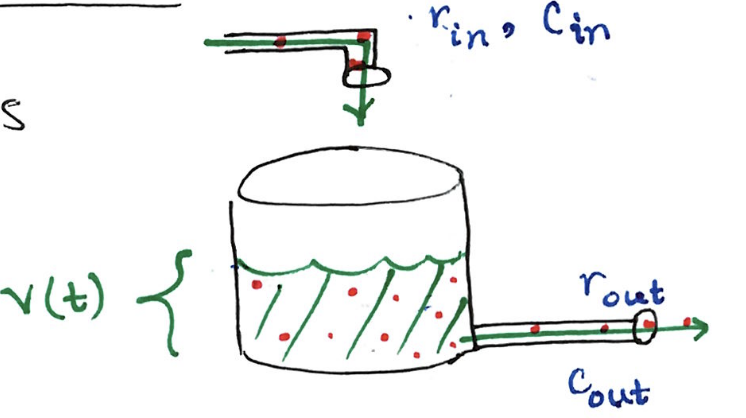
The goal is to model the amount \(A(t)\) of a substance in a solution over time.
- \(v(t)\): Volume of solution (L, gal, etc.)
- \(r_{in}, r_{out}\): Flow rates (gal/min, L/hr, etc.)
- \(c_{in}, c_{out}\): Concentration/Density (kg/L, lbs/gal, etc.)
The change in amount \(\Delta A\) over a small time interval \(\Delta t\) is given by:
$$\Delta A = (r_{in}c_{in} - r_{out}c_{out})\Delta t$$
Taking the limit as \(\Delta t \to 0\):
$$\frac{dA}{dt} = r_{in}c_{in} - r_{out}c_{out}(t)$$
If the solution is "well-mixed," we assume \(c_{out}(t) = \frac{A(t)}{v(t)}\). The resulting Ordinary Differential Equation (ODE) is:
$$\frac{dA}{dt} + \frac{r_{out}}{v(t)}A(t) = r_{in}c_{in}$$
This follows the standard form: \(y' + P(x)y = Q(x)\).
Solving the General First-Order Linear Equation
General form: \(\alpha(x)y' + \beta(x)y = \gamma(x)\)
Standard Form: Normalize by dividing by \(\alpha(x)\) to get:
$$y' + P(x)y = Q(x)$$
The Integrating Factor Method
- Find the integrating factor \(\rho(x) = e^{\int P(x) dx}\).
- Multiply the standard form equation by \(\rho(x)\):
$$\rho y' + \rho P y = \rho Q$$
- Recognize the left side as a product rule: \((\rho y)' = \rho Q\).
- Integrate both sides and solve for \(y\):
$$y = \frac{\int \rho Q dx + C}{\rho}$$
Example 1
Find a general solution for \(y' - y = 3e^{-x}\).
Step 1: Identify \(P(x) = -1\) and \(Q(x) = 3e^{-x}\).
Calculate \(\rho = e^{\int -1 dx} = e^{-x}\).
Step 2: Multiply and integrate.
\((e^{-x} \cdot y)' = e^{-x}(3e^{-x}) = 3e^{-2x}\)
\(e^{-x} y = \int 3e^{-2x} dx = -\frac{3}{2}e^{-2x} + C\)
Step 3: Solve for \(y\).
\(y = -\frac{3}{2}e^{-x} + Ce^x\)
Example 2
Find a general solution for \(xy' - 5y = x^6 \cos(x)\).
Standard form: Divide by \(x\) to get \(y' - \frac{5}{x}y = x^5 \cos(x)\).
Step 1: \(\rho = e^{\int -\frac{5}{x} dx} = e^{-5 \ln|x|} = x^{-5}\).
Step 2: \((x^{-5} y)' = x^{-5}(x^5 \cos(x)) = \cos(x)\).
\(x^{-5} y = \int \cos(x) dx = \sin(x) + C\)
Step 3: \(y = x^5 \sin(x) + Cx^5\).
Initial Value Problem (IVP)
If given \(y(\pi/2) = 0\):
\(0 = (\pi/2)^5 \sin(\pi/2) + C(\pi/2)^5\)
\(0 = (\pi/2)^5 (1 + C) \implies C = -1\).
Solution: \(y(x) = x^5(\sin(x) - 1)\).